On the Bougainvillea and Mitigation

Bougainvillea bract

Mit-i-gate verb: make less severe, serious or painful.

Removing a dead bougainvillea is a slow deliberate process. It must be done carefully to prevent bloodshed. Vicious thorns found on every twig and branch attack with little provocation. My removal method is to work from the outside in, cutting small pieces of twigs that will fit easily into the large trash can. Then I cut short lengths of the larger branches. I learned that trick the last time I had to remove a bougainvillea. You see, this is not my first rodeo with the bougainvillea plant. This job is so distasteful to me that I even did my taxes first.

The bougainvillea is a beautiful thorny plant native to South America often used in landscaping along the Texas Gulf coast. It doesn’t need a lot of water and blooms without much attention at all. The flowers are really quite small, but the surrounding specialized leaves called “bracts” give the bougainvillea the vibrant shows of color. Thick hedges of bougainvillea are sometimes used as security fences around homes deterring unwanted intruders. The vine versions can easily grow four stories high. And that growth can occur in a short period of time. My bougainvilleas grew over seven feet tall and seven feet around in one year. They normally flourish in this area, but we have had two cold winters in a row. After the freezing weather of 2012 killed one vine, I foolishly replaced it with another. This winter was even colder than last winter. That replacement bougainvillea is the one I am removing now, very carefully one branch at a time.
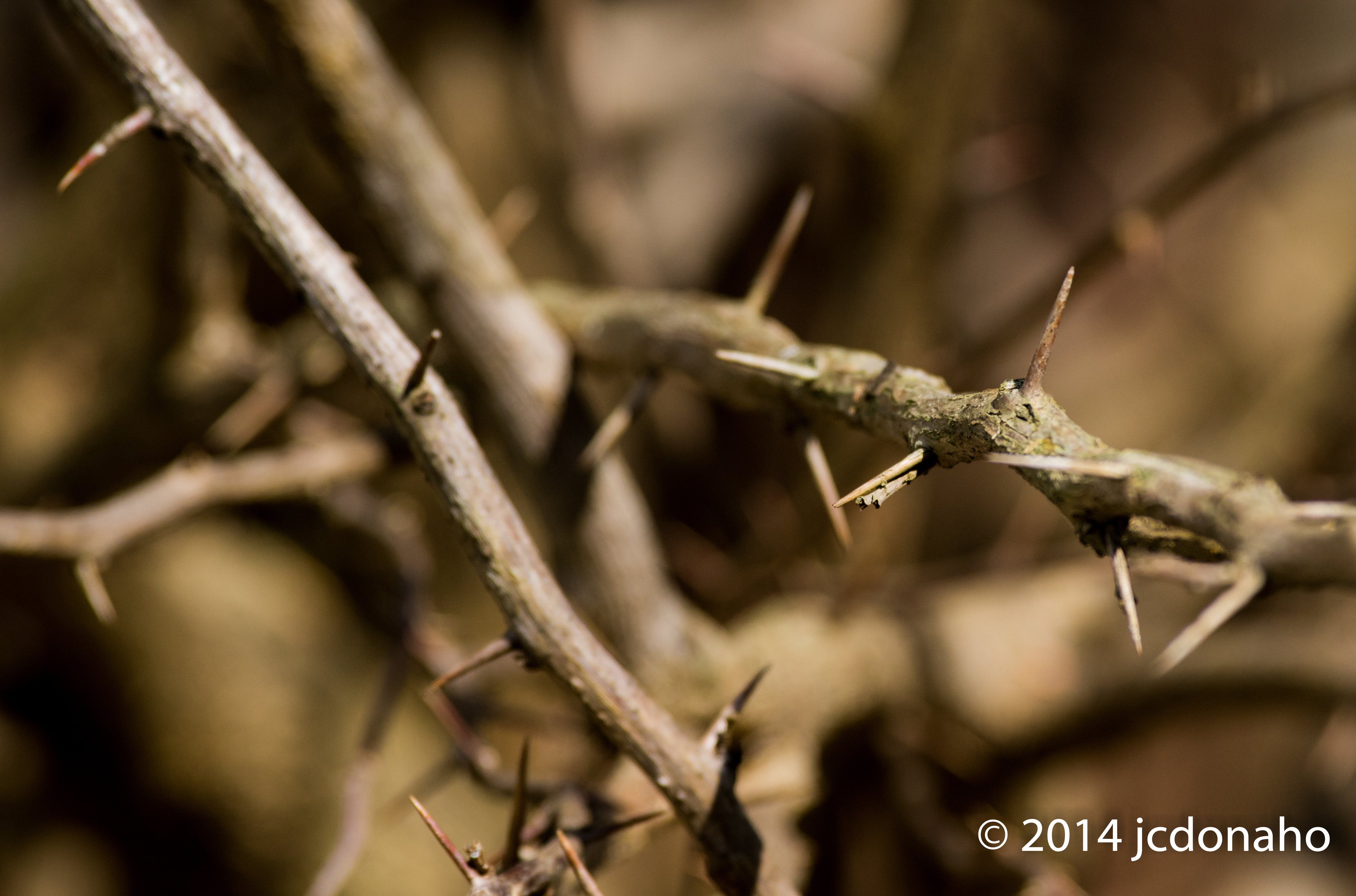
Bougainvillea thorns

Bougainvillea thorns


If I was out in the country and were the plant not so close to my fence and garage, I would be tempted to take a flame thrower to it. There is no way to grab the plant without getting stuck by a thorn. I’m sure it would be satisfying to burn the thorny thing down. But I have this nagging fear that the thorns will become flame hardened and get me anyway. So here I am clipping one twig and branch at a time and then using the clippers as a claw to manipulate the cutting into the trash can much like Homer Simpson manipulates the radioactive capsules at the reactor. Care must also be taken to remove any cuttings that fall on the ground to prevent thorns from penetrating shoes and feet.

Yes, this is a hazardous assignment. Even after some close calls I am unscathed, although there is still half to go. I’ll keep the band-aids close at hand.

So what does this have to do with mitigation?

I am mitigating this situation by planting something different this spring. Exactly what will be planted hasn’t been decided. I do know that it will be something without thorns. And that new plant will have to form a screen. The bougainvillea was doing a great job of hiding a worn section of fence next to the garage. So in addition to planting something new in that spot, I’ll need to replace a section of fence. That will mitigate a painful letter from the homeowners’ association.

So, mitigation can take many forms. It might be something as complicated and expensive as making sure emergency generators are located in safe locations. Or it might be additional training so employees know what to do in an emergency. Or it might be as simple as planting a non-thorny shrub.

A Lesson for All of Us

Flooded New Orleans

Flooded New OrleansHurricane Katrina proved to be an epic lesson in preparedness. From the individual level all the way to the highest levels of the federal government, failures to plan and mitigate ended in disaster. We are still learning lessons from that terrible storm in August of 2005. A recent book, Five Days at Memorial by Sherri Fink, is one of the more gut wrenching efforts to document what can happen when disaster strikes. Health care professionals at New Orleans’ Memorial Medical Center faced the ultimate nightmare scenario. They were left to decide those they could help and those they could not help. The last remaining back-up electrical generator had failed. Emergency batteries providing the last hope for life support equipment had nothing left to give. There is no question that everyone involved in those terrible hours were heroes in their attempts to provide for the patients. Building maintenance personnel performed extremely dangerous procedures attempting to keep power going in the building. Doctors and nurses did everything possible to save their sickest patients. But it was not enough.

The word “mitigation” is thrown around a lot. But it is an important word and concept. So many of the problems seen at Memorial Medical Center could have been mitigated either by building design or by more effective management practices. With the number of flooding disasters in recent years, those involved with building design and operation should understand the folly of placing critical infrastructure below grade. Back-up electrical generators will not run underwater. Oh, but it has never flooded at that location. All that can be said is that it has not flooded there yet. Mitigation moves that critical infrastructure above flood levels. It is important to remember that floods are not always related to a storm event.

A different maintenance routine and generators designed for long term use could have delayed some of the problems. Running a generator for a short time once a month is not enough as they found out. Weekly start-ups and then, longer 24 hour runs under load once a month might have revealed problems with the system before it was needed. That is what mitigation is all about. Finding problems and solving them before a procedure or piece of equipment is needed.

Five Days at Memorial is not a light read. In fact it can be painful. But it is full of lessons for all of us who plan for disasters. I am mentioning the book only from the standpoint of emergency preparedness. A lot of the book delves into the ethics of euthanasia and the medical personnel involved in a controversial way.

1,000,000 Gallons of Water Flood Building!

flooded floor

The headline is stark. But this was not from a rising river. This was from a broken fire sprinkler system within the building. One of the problems with this event is that the break was not discovered until an employee came in early to do some work. By that time the water was eight feet deep in the basement. As is very common in building design, the electrical and elevator systems were located in the basement and were inundated.

Water in a building can be devastating. Water in a basement with critical infrastructure can result in long lasting interruption to business activities in that building. It is also very expensive. Water removal, building dry out, mold removal, damage to equipment, replacement of supplies and loss of business cost money. These costs may or may not be covered with insurance or FEMA assistance. In the case of FEMA, only a portion of losses can be recovered.

Prevention is often impossible. Things happen. Pipes break, sprinkler heads pop off or a valve may malfunction. Maintenance can help some of that, but “IT” happens somewhere everyday.iStock_000010866677Small

Early warning is key. The first question I have in a situation like this is why there was no flow alarm on the sprinkler system? A sensor within the fire sprinkler system should have sounded audible and visual alarms as well as send a signal to a monitoring station. Water flowing in a sprinkler system should trigger the fire alarm automatically. Either those things didn’t happen or there was no one to see and hear the alarms.

Any facility with important infrastructure located below ground should also have water alarms. These simple devices tied into the building alarm system detect water on the floor sounding an alarm to mitigate potential damage. This can provide warning when water from outside the building floods a basement whether from flooding rains or from a water main break next door.

The ultimate mitigation to this sort of damage is careful consideration of locating critical electrical controls, emergency generators and other important infrastructure in basements.

http://www.koco.com/news/oklahomanews/okc/okc-city-building-flooded-with-more-than-1-million-gallons-of-water/-/11777584/24249532/-/15cbu23/-/index.html?showAds=0